

Each month I try to share something I learned. This month the lesson did not come from a data set or a client engagement. It came from a small wooden house full of children’s books.
Since 2018, Holland’s two Rotary clubs have partnered with Herrick District Library on the Holland Rotary Book House project. The first house went up at Nuestra Casa, a community center in Holland’s Westcore neighborhood. The idea came from a committee of Rotarians working with Herrick’s community outreach librarian. Rotarians developed the design, secured the materials, and built the original houses.
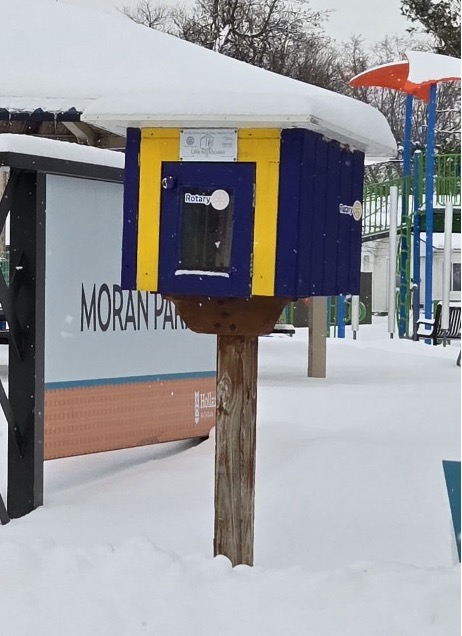
The Book House at Moran Park stays open all winter.
Today, 17 Book Houses stand near playgrounds, apartments, mobile-home parks, schools, and subsidized housing across the greater Holland area. The library, area schools, community donors, and local bookstores supply gently used books. Volunteers keep the houses stocked, repaired, and painted Rotary blue and yellow.
The Rotarians who tend the Quincy Park house see the impact firsthand. When they restock it, children leave the playground to gather around. Their faces, and their parents’ faces, light up when the volunteers explain they can choose several books and keep them, no strings attached. In summer the house often needs refilling every week.
Our Rotarians like to compare the project to Dolly Parton’s Imagination Library, because both help children build libraries of their own. That ownership matters. A book a child keeps can be reread, shared with a sibling, or carried to school.
Three lessons for economic developers
First, remove friction. The Book Houses work because there is no registration, no due date, and no trip across town. How many of our business assistance programs require a form, a meeting, and a wait before a company receives anything of value? The easier we make the first step, the more people take it.
Second, partnerships multiply small budgets. Two Rotary clubs and a public library, each contributing what it does best, built something none of them could sustain alone. That is the same formula behind every strong regional partnership I have seen.
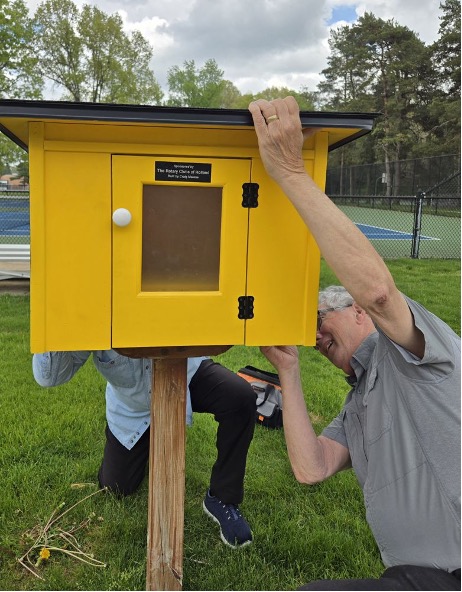
Volunteers install a new Book House.
Third, literacy is workforce development with a very long lead time. The companies we court fifteen years from now will be hiring today’s grade schoolers. A child who grows up owning books is building the foundation every employer eventually depends on.
I saw that future in a single moment. When volunteers installed a Book House at housing for migrant workers, an 11-year-old boy took several books to a picnic table, invited the younger children to join him, and began reading aloud. In minutes, a wooden box became a neighborhood reading room.
Not every community asset needs a ribbon cutting or a bond issue. Sometimes it starts with donated books, a willing volunteer, and a little house within a child’s reach.